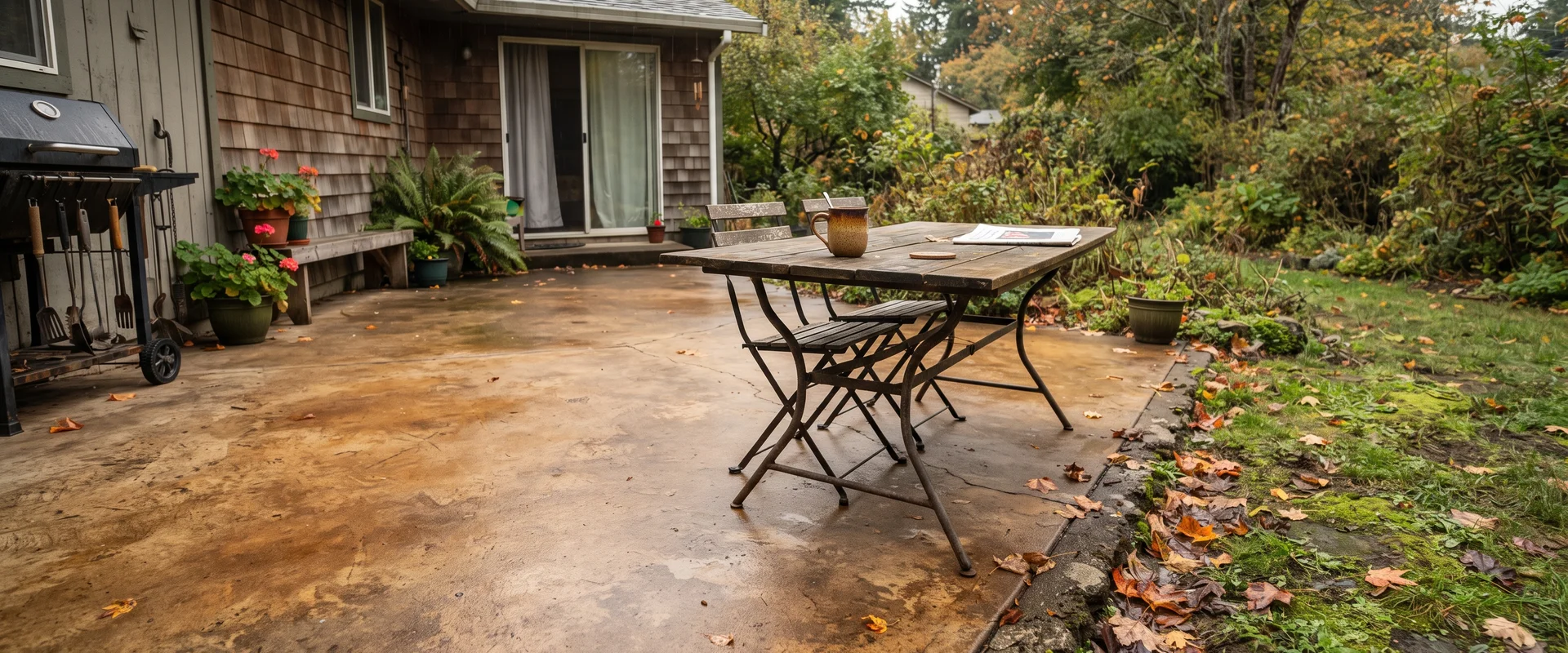
Acid-stained concrete patio in warm brown tones outside a Eugene home

Decorative Concrete Overlays & Staining in Eugene

Overlay resurfacing plus custom stains and dyes to restore and beautify damaged concrete indoors and out.

  • Licensed, insured & bonded
  • 15+ years experience
  • Warranties included
5.0 (Dozens of projects)
Licensed, Insured & Bonded
Free In-Home Estimates
15+ Years Experience

What Are Decorative Overlays and Staining?

These are two techniques that solve two different problems, and most projects use one or the other rather than both. Both sit at the decorative end of the concrete floor coating and polishing work we do in Eugene, where the goal is how the slab looks rather than only how it performs.

A concrete overlay is a thin cementitious layer trowelled over an existing slab. It is what you use when the surface itself has failed: spalling, surface restoration after freeze-thaw damage, scaling from de-icer, or a finish that was never right in the first place. A microtopping can be laid barely a millimetre thick for a smooth modern interior floor, while heavier overlays rebuild worn exterior concrete back to a sound, even surface. Either way you keep the existing slab and skip demolition.

Staining is for slabs that are structurally fine but visually tired. Acid stain reacts with the free lime in the concrete and produces mottled, variegated color with real depth, the kind that looks like weathered stone rather than paint. Concrete dye is a penetrating pigment that gives more even, saturated color and reaches tones acid stain simply cannot, including greys, blues and blacks. We use both, sometimes layered on the same floor to get depth and control.
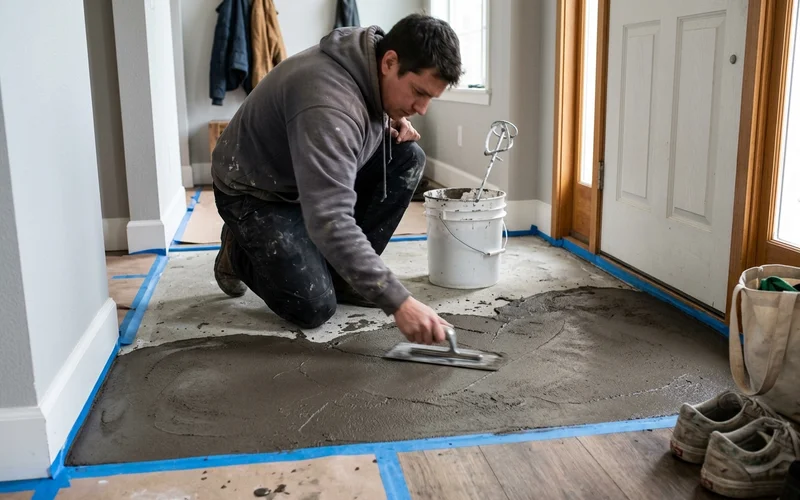
Trowelling a decorative microtopping overlay across a prepared concrete surface

TechniqueBest ForKey Benefit
Acid StainPatios and entryways with sound concreteMottled, variegated color with real depth, like weathered stone.
Concrete DyeInterior floors needing precise colorEven, saturated tones acid stain cannot reach, including greys and blacks.
Overlay / MicrotoppingSpalled or freeze-thaw damaged slabsRebuilds a failed surface without demolition.

Both start with the same non-negotiable step. The slab gets diamond ground to strip old sealer, paint and coatings and to open the surface. Nothing bonds to a sealed slab and nothing stains through one. Crack repair happens before any color goes down, because a filled and ground crack disappears while an ignored one shows through everything.

Color work finishes with a sealer chosen for the exposure. Interior floors take a matte or satin film that keeps the color rich and cleans easily. Exterior patios and walkways take a breathable, UV-stable sealer with an anti-slip additive worked in, because a glossy sealed patio in Oregon rain is a hazard.

What’s Included

  • Assessment of the slab and the cause of the existing damage
  • Diamond grinding to remove sealer, paint and coatings
  • Crack routing, filling and spall repair
  • Overlay or microtopping application where the surface needs rebuilding
  • Acid stain or dye in your chosen color palette, neutralized and rinsed
  • Optional saw-cut patterns, borders and stencilled detail
  • Sealer specified for interior or exterior exposure, with anti-slip additive outdoors

Common Problems We Solve

Patios That Have Weathered Badly

Oregon winters are hard on exterior concrete. Freeze-thaw cycling lifts the surface paste, leaving a rough, patchy slab. An overlay rebuilds it back to a flat, even surface and stain gives it a color that suits the house.

Interior Slabs Under Removed Flooring

Pull up carpet or vinyl and you find adhesive, tack strips and staining. Rather than laying new flooring over it, grinding it back and staining the concrete turns the problem into the finished floor. Where the slab underneath is sound and attractive on its own, polished concrete is often the better answer than adding color.

Concrete That Does Not Match the House

Plain gray concrete rarely does a home any favors. Color is the cheapest change with the biggest visual return, especially on entryways and courtyards that are the first thing a visitor sees.

Cracks That Keep Getting Worse

Water gets into a crack, freezes, and widens it. Routing, filling and resurfacing seals the path so the damage stops progressing instead of spreading every winter.

How Long Does Stained Concrete Last?

The color is effectively permanent because it is inside the concrete rather than sitting on top of it. What wears is the sealer, and refreshing a sealer is a straightforward maintenance job, not a re-do. Interior floors typically go several years between coats. Exterior surfaces in the Willamette Valley are usually best resealed every two to four years depending on sun exposure and traffic. We show you what that involves at handover so you can either do it yourself or book us.

Serving Eugene, Springfield, Junction City, Cottage Grove and the wider Willamette Valley.
Transparent Pricing

How Much Does Overlays & Staining Cost in Eugene?

Real numbers up front. Your written estimate confirms the exact price for your slab after a free in-home visit.

Typical range

$ 3 – $9

per sq ft (design & condition dependent)

Final pricing after a free estimate.

Get Free Estimate

What Changes the Price on Your Floor?

  • How much repair the existing slab needs before resurfacing
  • Overlay thickness: a skim coat versus a full microtopping build
  • Single color stain versus layered, variegated color work
  • Saw-cut patterns, borders and stencilled detail
  • Interior versus exterior, and the sealer specified for each

Prices vary with slab condition and prep. Call 541-203-3668 or book a free in-home estimate for a firm number.

Why Us

Why Choose Us for Overlays & Staining?

Restore Instead of Replace

Resurfacing a tired patio or entry costs a fraction of tearing out and re-pouring, and it takes days rather than weeks.

Color You Actually Choose

Acid stains give mottled, variegated depth. Dyes give consistent, saturated color. We sample both on your slab before committing.

We Fix the Cause First

Cracks get routed and repaired, spalled areas rebuilt. Color over a failing surface is money spent twice.

Indoor and Outdoor

Interior floors, entryways, patios and walkways, each with a sealer specified for that exposure rather than one product used everywhere.

Oregon Weather Realism

Exterior work gets scheduled around dry windows. We would rather move a date than seal a damp slab and hand you a cloudy finish.

Licensed, Insured & Bonded

Oregon CCB registered with 15+ years of decorative and structural concrete work behind the crew.

Step by Step

How Our Overlays & Staining Service Works

  1. 01

    Assess and Repair

    We look at what caused the damage first. Spalling, surface cracking and delamination all get repaired properly, because an overlay laid over a failing surface fails with it.

  2. 02

    Mechanical Prep

    Diamond grinding opens the slab and removes old sealer, paint and coatings so the overlay or stain can bond and take color evenly.

  3. 03

    Overlay or Direct Stain

    Where the surface is damaged we trowel a cementitious overlay or microtopping to give you a fresh canvas. Where the slab is sound we stain it directly and keep the original character.

  4. 04

    Color and Seal

    Acid stain or concrete dye goes on in your palette, gets neutralized and rinsed, then a sealer locks the color in with your choice of matte or satin sheen.

Not sure which floor system you need?

Tell us how the space gets used and we will recommend the system that fits, not the most expensive one.

Our Work

Overlays & Staining Projects

Click any image to enlarge.

Results

See the Difference

Before Weathered, spalled concrete patio with cracking and moss in the joints
After The same patio resurfaced with a decorative overlay and warm stain

Overlays & Staining transformation on a Lane County project

Testimonials

What Customers Say About Our Overlays & Staining

5.0 average across our completed projects
“Our concrete was cracked and stained and we assumed it had to be replaced. They resurfaced it instead and it looks better than the original.”
Ruth A.
Cottage Grove, OR
“Easy to deal with, showed up when they said they would, and the price on the invoice matched the quote.”
Lisa H.
Junction City, OR
“The stained entryway ties the whole front of the house together. They matched the tone we wanted on the second sample.”
Dana K.
Churchill, Eugene
Got Questions?

Overlays & Staining FAQs

What is a concrete overlay?

It is a thin cementitious layer trowelled over your existing slab to give you a fresh, sound surface. A microtopping can be as thin as a credit card for a smooth interior finish, while thicker overlays rebuild worn or spalled exterior concrete.

What is the difference between acid stain and concrete dye?

Acid stain reacts chemically with the lime in the concrete, producing mottled, variegated, earthy color with a lot of depth and permanence. Dye is a pigment that penetrates and gives more consistent, saturated color including tones acid stain cannot reach. We use both, sometimes on the same floor.

Can you cover cracks with an overlay?

We repair cracks first, then overlay. Static shrinkage cracks are routed, filled and disappear under the new surface. A crack that is still moving will eventually show through any topping, and we will tell you that up front rather than after.

How long does stained concrete last?

The color is permanent because it is in the concrete rather than on it. What wears is the sealer, and that is the part you refresh. Interior floors often go many years between sealer coats. Exterior patios in Oregon weather usually want resealing every two to four years.

Will an exterior stained patio be slippery when wet?

It depends on the sealer. For patios, walkways and pool surrounds we add a fine anti-slip additive into the sealer, which raises traction without changing the appearance. Wet-area surfaces should never be finished with a bare high-gloss sealer.

Can you color-match something specific?

We can get close, and we always sample on your actual slab first. Concrete is a reactive substrate, so the same stain reads differently on different pours. Sampling in place is the only honest way to show you the result.

Can this go over an existing coating or sealer?

Not directly. Old sealers, paint and coatings all have to be ground off first so the overlay can bond and the stain can penetrate. That removal is part of the quote.

How long does the work take?

A straightforward interior stain and seal is typically two days. An overlay with repair, color and sealer usually runs three to four. Exterior work is weather-dependent and we build that into the schedule.

Is it suitable for a driveway?

Yes, with the right specification. Driveways need a thicker overlay and a sealer rated for vehicle traffic and UV. A thin decorative microtopping designed for an interior floor will not survive under tires.

What does it cost compared to replacing the concrete?

Resurfacing generally runs $3 to $9 per square foot depending on the condition and design, which is usually well under the cost of demolition, disposal and a new pour, and it avoids the cure time and disruption of replacing the slab.

Still have questions?

Tell us about your floor and we'll give you a straight answer, plus a free in-home estimate.

Free in-home consultations

Ready to Book Overlays & Staining?

Free in-home estimates on decorative concrete overlays & staining across Eugene and the Willamette Valley, with written pricing before we start.

  • Licensed, insured & bonded
  • Warranties included
  • Low-VOC premium products
Call Now