What Is Polished Concrete?
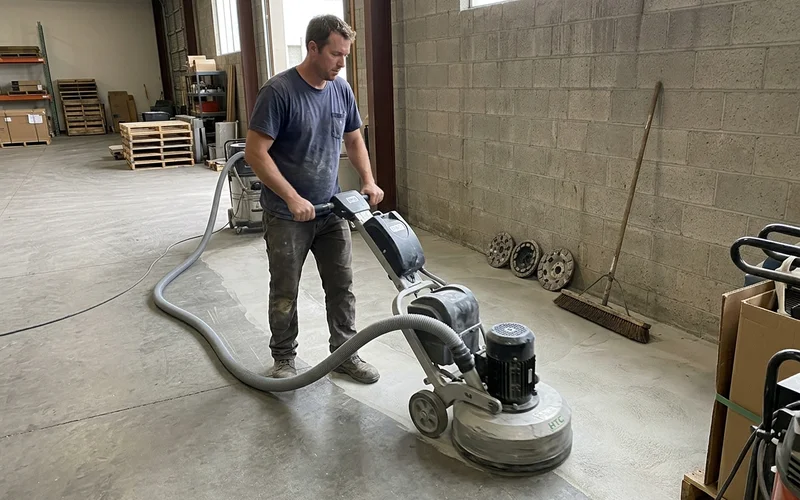
Polished concrete is not a product you put on a floor. It is a process that turns the slab you already own into the finished surface. We refine it with diamond abrasive tooling on planetary grinders, harden it chemically with a liquid densifier, then polish it up through progressively finer grits until it reaches the sheen you asked for.
Because there is no coating involved, there is nothing to delaminate, peel, chip or scratch off. The wear layer is the concrete. That is why a polished floor in a busy warehouse can still look sharp two decades later while a coated floor in the same aisle has been recoated twice. It is the finish we recommend most often when a slab is sound, and one of the concrete floor systems our licensed Eugene crew installs across the Willamette Valley.
The densifier is the step that separates a real polish from a machine buffing. Sodium or lithium silicate penetrates into the pores and reacts with the free lime in the concrete, forming additional hardened material inside the slab. That raises surface Mohs hardness, closes the pores that shed dust, and gives the finer polishing passes something hard enough to bring to a shine. Skip it and the gloss burns off within months.
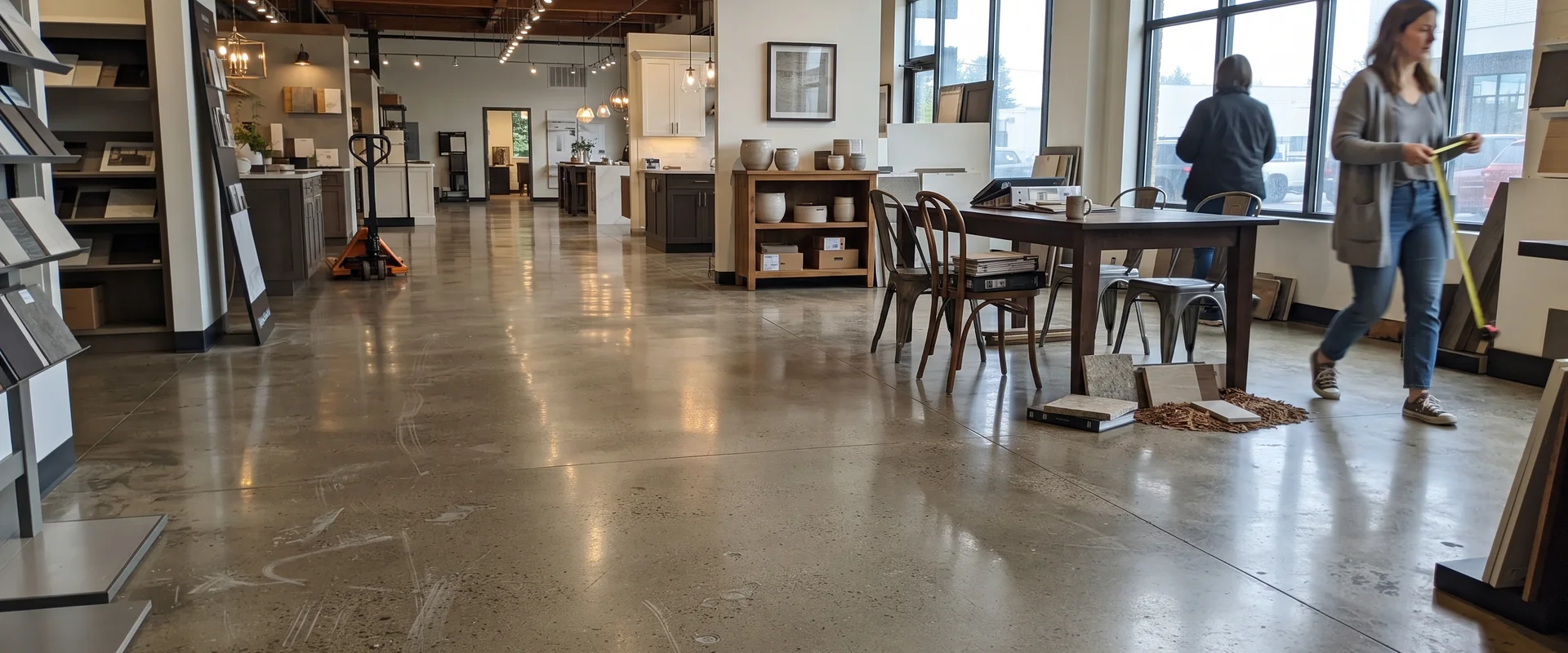
You choose the finish in two dimensions. Gloss runs from a soft matte finish, which hides footprints and scuffs, up to a high-gloss finish that mirrors overhead lighting. Aggregate exposure runs from a cream polish with almost no stone visible, through salt-and-pepper, to full stone exposure. We bring samples and talk through what your particular slab can realistically deliver, because aggregate distribution varies pour to pour and no honest contractor promises a look they have not verified.
| Finish Level | Best For | Key Benefit |
|---|---|---|
| Honed Matte | Homes and workshops | Hides footprints and scuffs, with the best traction underfoot. |
| Satin Semi-Gloss | Offices and retail floors | Balanced sheen that lifts room brightness without heavy glare. |
| High-Gloss Mirror | Showrooms and warehouses | Maximum light reflectance, often cutting overhead lighting needs. |
Once the polish is where you want it, a penetrating stain shield goes in. It sits inside the surface rather than forming a film on top, so coffee, oil and forklift fluid have time to be wiped up rather than soaking straight in.
What’s Included
- Slab assessment for hardness, flatness and existing coatings
- Coarse metal-bond grinding to remove coatings, glue and mastic
- Dustless HEPA vacuum extraction on every machine
- Crack and joint repair before the finish passes
- Lithium or sodium silicate densifier (concrete hardener) application
- Progressive resin-bond polishing to your chosen gloss level
- Penetrating stain shield and hand-edging along walls and columns
Common Problems We Solve
Concrete Dust on Everything
Untreated slabs shed fine dust continuously. In a warehouse it settles on product, in a home it coats every surface in the basement. Densifying closes the pores and stops it at the source rather than sweeping it around forever.
Warehouse Floors That Cannot Take Another Coating
Some industrial floors have been coated and recoated until nothing bonds reliably any more. Grinding the whole history off and polishing the bare slab gives you a floor with no film to fail and effectively no recoat cycle. Where chemical exposure or wash-down heat rules polishing out, we specify industrial concrete coatings instead.
Dim Facilities With High Lighting Bills
Bare concrete absorbs light. A polished floor has high light reflectance, which brightens aisles and work areas noticeably and often lets facility managers reduce fixture counts or run fewer lights.
Floors That Need Constant Waxing
VCT and sealed floors need stripping and waxing on a schedule that costs real money every year. A polished floor needs a dust mop and an occasional damp mop, and that is the entire maintenance program.
How Much Does Polished Concrete Cost in Eugene?
Most projects land between $3 and $10 per square foot. A honed matte finish on a sound, clean slab sits at the low end. A mirror-gloss finish with heavy aggregate exposure, coating removal and joint repair sits at the top. Larger open areas cost less per square foot than small rooms with a lot of hand-edging, because edge work is slow and cannot be done with a walk-behind machine.
Serving Eugene, Springfield, Junction City, Cottage Grove and the wider Willamette Valley.